Dō (道) and Jutsu (術): The Way and the Technique in Japanese Martial Arts
Technique versus Path — What We’re Actually Cultivating When We Train
ARTICLE
4/14/20266 min read

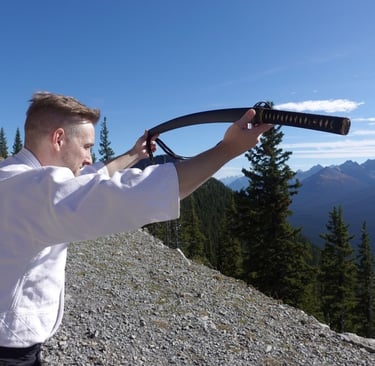
Many of us that practice Japanese martial arts eventually run into these words and wonder what the distinction is. I think for most westerners we are familiar with Judo and Kendo as these are popular sports. For those that have interest in Japanese sword, they may find Iaido which has been popularized in Japan and globally by the All Japan Kendo Federation (全日本剣道連盟, Zennihon Kendō Renmei). Some prospective students inquire if they can learn iaido from us. Technically we practice Iaijutsu, but of course, I answer 'yes' as the difference for most is so subtle, especially to the lay person.
For me, I started in Karate Dō and understood early that this martial art was a path and for many a “way of life.” Much later, after taking on Aikidō, I was introduced to other systems of martial arts such as kenjutsu and jujutsu and had to ask how is it different and why do we use the term “jutsu.” What is budo and what is bujutsu?
And at first glance, it is simply this:
術 (jutsu) means technique—method, skill, something you can do
道 (dō) means way—a path, something you follow
It’s straight forward enough, but like most things in martial arts, there is a bit more to it.
Before “the Way”: a world of technique
If we go back to the Edo period or prior, the situation was quite different. What we now group together under “martial arts” were not hobbies, nor were they vehicles for self-improvement, and certainly not cultural pastimes. They were systems—often highly specialized and tightly preserved within ryūha—and they existed for a reason.
There are the well know arts – kenjutsu, jujutsu, sōjutsu, and then there are the lesser know arts of horse riding (bajutsu), swimming in armour and crossing water ways (suijutsu)
These were practical methods and functional bodies of knowledge, shaped by a world in which violence was not theoretical. Training was not about “finding oneself.” It was about surviving and prevailing. What worked was transmitted; sometimes only within families and clans.
That doesn’t mean they were crude or purely mechanical. In fact, the Edo period was one of refinement of martial arts. Anyone who has spent time in a classical tradition knows how much depth—technical, strategic, and philosophical—runs through them and this depth was anchored in reality. The question underneath everything was still:
Does this hold up when it matters?
And it helps explain the plethora of arts that had come and gone and adapted
Given the above context, jutsu makes perfect sense. It describes exactly what is being cultivated: skill.
The idea of “dō” already existed
What’s often missed in modern discussions is that dō did not originate in martial arts.
Long before anyone spoke of kendō or aikidō, the concept of “dō” (道) already existed in Japanese culture. It appeared in refined traditional arts such as sadō (or chadō) — the way of tea, shodō — the way of calligraphy, and kadō — the way of flowers.
In these arts, technique was never absent—quite the opposite. Precision mattered. Form mattered. Repetition mattered. But the purpose of that repetition extended beyond the technique itself.
The practice was understood as a path of cultivation.
Not in a vague or mystical sense, but in a very concrete one: through sustained, disciplined engagement with form, something in the practitioner is shaped. Attention sharpens. Conduct refines. Character develops. The “way” is not separate from the technique—the way is the practice.
So this idea was already part of Japanese culture. In the peace of the Edo period, the martial arts did not disappear—they were refined. Stripped of the urgency of the battlefield, the schools turned inward. They refined technique and practice and became more systematized and codified. What had once been techniques of survival were distilled into forms through which the practitioner could refine body, mind, and perception. This is the origin of what we now call “the Way.”
The Meiji rupture
In the late 19th century, the context that had sustained the older arts disappeared.
The Meiji Restoration dismantled the samurai class. Sword wearing was banned. The social and military structures that had made martial training essential were replaced by something entirely different - modern conscript army with rifles and artillery, Western military training. Within a generation, arts that had once been necessary were, in a practical sense, obsolete.
At that point, a question couldn’t be avoided:
If these arts are no longer needed for combat, what are they for?
There were different answers. Some traditions narrowed, preserving what they could. Others adapted more radically.
One of the most influential responses came from Kanō Jigorō, who in 1882 founded jūdō (柔道).
After the Meiji Restoration jūjutsu schools were declining. Many were seen as dangerous, outdated and lacking educational value. At the same time, Japan was building a modern school system. Kano recognized that if martial arts remained as they were, they would disappear.
A deliberate shift: from jūjutsu to jūdō
Kanō’s decision to use dō instead of jutsu was not cosmetic.
He took techniques drawn from jūjutsu traditions and reorganized them into something that could be practiced safely, systematically, and—critically—within an educational framework. Jūdō was introduced into schools. It was presented not just as a physical discipline, but as a means of developing the individual.
This wasn’t a rejection of technique. It was a recontextualization.
Technique was still essential—but it was no longer the endpoint. It became the vehicle for something broader: discipline, judgment, cooperation, resilience. In other words, it aligned with the existing cultural idea of a “way.”
That shift proved influential. Over time, other arts followed similar paths. Kendō emerged from various kenjutsu traditions as a standardized practice. Karate-dō reframed striking methods within a model of lifelong training and personal development. Aikidō, developing out of Daitō-ryū, emphasized harmony and non-conflict alongside technical practice with the ultimate goal of bringing peace to the world.
The language of dō spread because the purpose of training had changed.
The distinction—and its limits
From here, it’s tempting to draw a clean line.
Before Meiji: jutsu—practical, combative.
After Meiji: dō—philosophical, developmental.
This is useful, but incomplete.
The older traditions were never devoid of philosophy. Many contain sophisticated approaches to timing, perception, intention, and mental state that go far beyond “just technique.” Conversely, modern dō arts have never escaped the need for technical precision. A poorly executed throw is still a poor throw, no matter how refined the intent behind it is supposed to be.
Even today, the terms don’t behave consistently. Some arts use both: iaidō and iaijutsu, jōdō and jōjutsu. Sometimes the difference signals a shift in emphasis—toward preservation and transmission in one case, toward personal cultivation in another. Sometimes it reflects lineage, branding, or simple convention.
And sometimes, if we’re honest, it’s used more as a statement of identity than a meaningful distinction.
Two ways of looking at the same practice
A more useful approach may be to stop treating dō and jutsu as opposing categories.
Instead, think of them as two perspectives.
From one side, training is about how:
How is this done? What makes it effective? What has been passed down, and how accurately can it be maintained?
From the other, training is about what it does:
What does this practice produce in the person who engages in it over time?
In serious practice, these are not separate questions.
Technique without direction becomes empty repetition. A “way” without technical substance dissolves into abstraction. The depth of training comes from the tension between the two—the constant requirement to refine what you do while also being shaped by it.
What are we preserving?
There is, however, one distinction that still matters.
In many classical traditions, what is being preserved is the art itself—a specific body of knowledge, with its own logic, history, and internal consistency. The practitioner’s role is, in a sense, secondary. One trains in order to receive, maintain, and transmit the tradition as accurately as possible.
In many modern dō contexts, the emphasis is reversed. The art is still important, but it is often understood as serving the development of the individual—physically, mentally, sometimes morally. The question becomes not only whether the art is preserved, but what it does for those who practice it.
Both approaches have value. Both can become distorted if taken too far.
Technique and path
So what is the difference between dō and jutsu?
Literally, it’s the difference between technique and path.
In practice, it’s the difference between two ways of understanding why we train—and what we believe we are responsible for.
But the longer one trains, the harder it becomes to separate the two.
Technique shapes the person. The person gives life to the technique. Over time, what begins as something you do becomes something you follow. And what you follow is sustained only through what you actually do.
In that sense, the distinction is real—but it isn’t a divide. It’s a relationship.
If you've enjoyed this brief article, please check out the numerous other articles on our site. Feel free to contact us with ideas for other article that we should write about.
Calgary Rakushinkan
カルガリー楽心館
Authentic Aikido and classical Japanese martial arts in Calgary.
LOCATIONS:
Mount Pleasant Community Association
602 22 Ave NW
Calgary, AB T2M 1N7
Winston Heights-Mountview Community Association
520 27 Ave NE
Calgary, AB T2E 2A6
© 2025. All rights reserved.